One person, one vote is a cherished principle, however, in most countries the representatives to the national legislative body come from certain fixed geographic regions. E.g., in the US Senators are elected from the states, while the members of the House of Representatives come from a congressional district.
In Norway, each of the 169 representatives in parliament, the Storting, comes from one of 19 counties. At the heart of the distribution of seats is a weighted sum of the number of inhabitants of a county and its area, calculated as follows: #inhabitants+1.8 x area in sq.m. So 1 sq.m. counts as 1.8 person. This is a systematic overrepresentation of people in counties with relatively low population density and corresponding underrepresentation of people in more densely populated counties.
How does this play out in practice? For the elections in 2005 and 2009, the seat allocation was based on the inhabitant count as of 2004-01-01. Below I have plotted the number of representatives per inhabitant against the number of inhabitants for all the 19 counties. Counties with few inhabitants tend to have more representatives per inhabitants. The most Northern county, Finnmark, is the outlier, with more than double the number of seats per inhabitant as several other counties. (Or in other words: Fewer than half the number of people behind a representative.)

Due to migration within the country and a small reform, the allocation for the elections of 2013 and 2017 is shifted somewhat. More populous counties will now be a little less underrepresented: 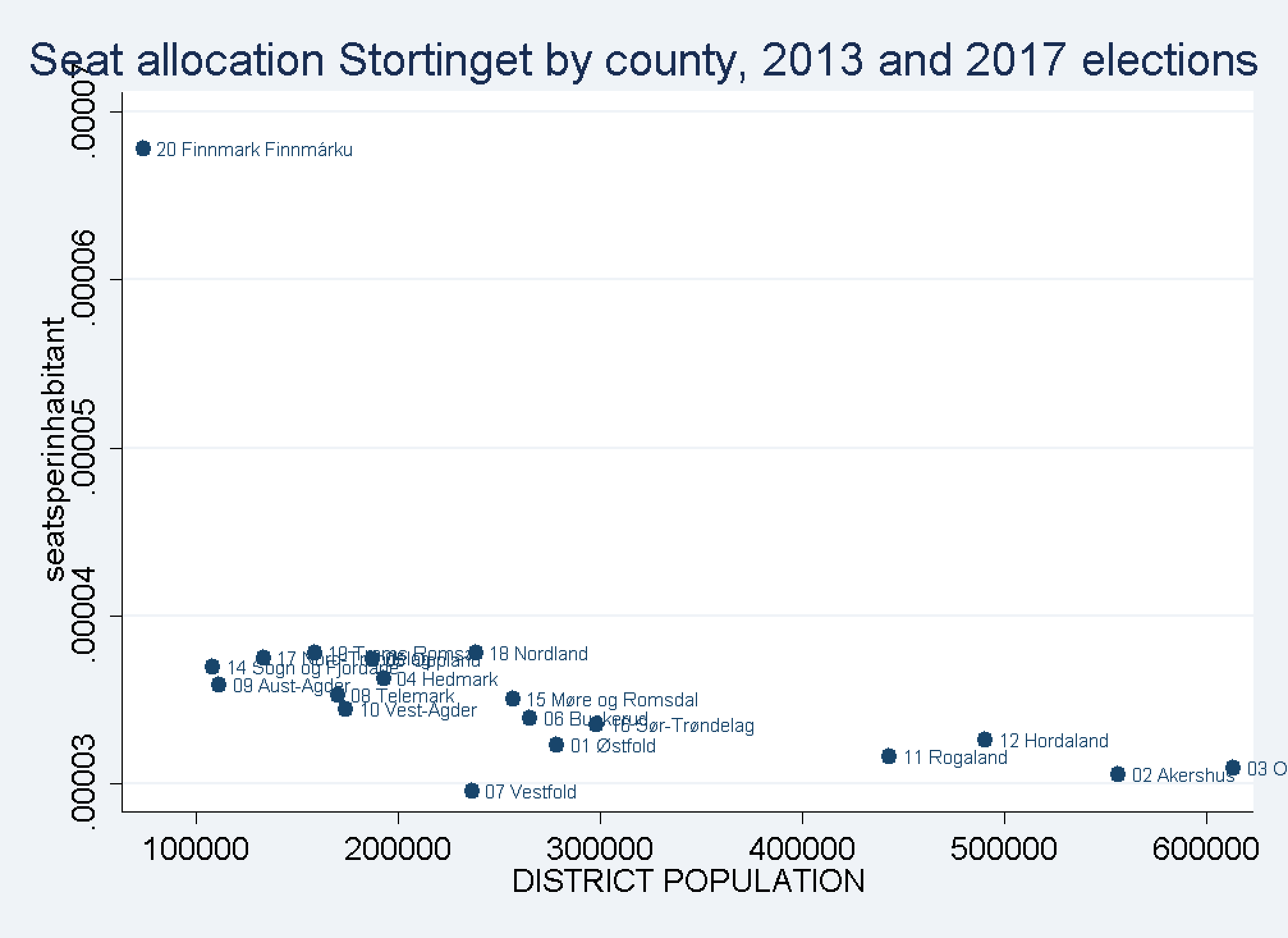
This topic is currently on my research agenda, so I will return to it in not too long. A seminal paper (pdf) by Samuels and Snyder, more countries on Andrew Gelman’s blog, discussions of representation in the US Senate on CrookedTimber and in the New York Times.
Update: for Norwegian readers: Discussions from the election in 2009, from Minerva, Aftenposten and Ferskvannsmandatet.
 , in which he among other things takes up the virtues of favoritism. I do not know if the framing the issue as a conflict between preference and fairness is a good one, but how we do in fact care differentially about others, and have few problems doing so, is an interesting topic.
 , by Rick Bragg. Nostalgic about Charlie Bundrum, an all-beloved family- and handyman living in the South during the great depression. Not without faults, but revered by everyone. Worked as carpenter, (bootleg) whisky-maker, and fisherman. A bygone time that was not long ago.
 , by Marina Lewycka. Ok.
 by Amy Wallace. The life of William James Sidis (1898-1944), wizard of mathematics, languages and much else. Probably well endowed naturally, and was taught to love learning and reasoning by his parents. It is striking how much of this upbringing is regarded as standard in many environments today: Answering children’s question seriously, talking to them as adults, learn them reasoning and principles rather than isolated facts and rigid rules. The author makes that case that WJS suffered from a dysfunctional relationship between his parents, having to be socially together with older others, and above all from being hunted on by the tabloid press. Made substantial contributions to mathematical physics, but eventually he retreated into anonymity and menial jobs, although still an intellectual firework in the areas that he did not leave behind, like politics and the collection of streetcar transfers(!). Although eccentric he did not appear bitter. The moral is nevertheless to treat children seriously as learners, but let them be children.
 by Booker T. Washington. Booker T. Washington was born into slavery in 1856. He lived as a slave until the end of the civil war in 1865, when his family was freed. He was determined to learn how to read and managed to obtain an education at the Hampton Institute, Virginia. A strong advocate of the importance of education for the black race. Apparently there were tensions between this approach and the more confrontational tone of many others in the black political community, but this is not something that is mentioned specifically in the book. Washington stressed the importance of learning a trade to become an integrated and valued member of society, and worked as an educator for most of his life, heading the Tuskegee Institute, Alabama, from 1881 until his death in 1915.
 by T. E. Lawrence. Unnuanced generalizations about nations, peoples, etc. Not engaging.
 Ø-blog