Tag Archives: books

Monthly book roundup – 2017 January

Books finished in January:
(Warning: reviews are unpolished and quickly written.)

The Sandman Vol. 1: Preludes & Nocturnes (New Edition) (1995) by Neil Gaiman. A classic of the graphical fantasy field. Though no fan of fantasy in general, I do believe having a go at the classics of any field. And I can definitely see the appeal of this work about Sandman/Dream/Morpheus getting captured by mere humans and the trouble that gets him into. However, even though this novel mainly sets the scene for the several later volumes of Sandman, I probably will not pick them up, I just like more realistic (less magical) stuff.

Ratings and previous books are in the library.

Less reading, more television

I have always liked time use surveys and would love to use them more, for example to write posts like this one at Vox. Now I have recently begun working a little with some such Norwegian surveys, so here is a little about recent developments in how young Norwegians spend their leisure time.
(Apologies for the unsatisfying look of some of the graphs, they are simply lifted from an online resource.)

figure_leisure_1970_2010

Percent spending time on various leisure activites an average day, 1970-2010.

In short, since 1970 fewer of us are reading an average day (turquoise), while more area watching television (light blue), and recently using internet (included in “Other” (dark brown)).

A bit more detailed look on average time for 1991-2005 confirms that television time is increasing; figure_media_minutesTVwatched1991_2005

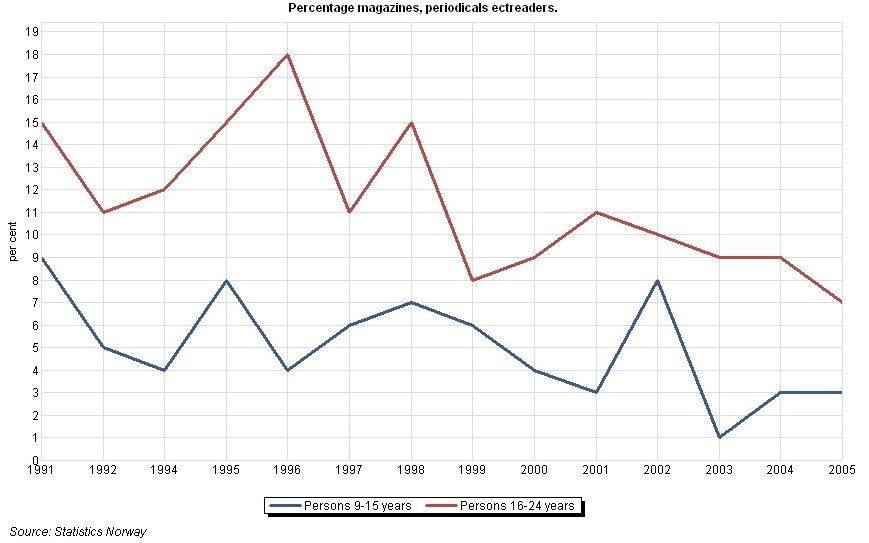
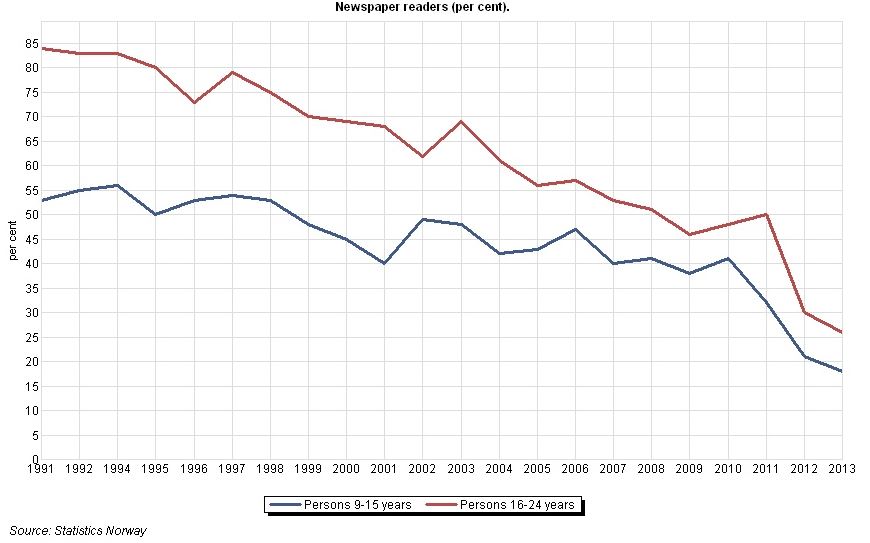
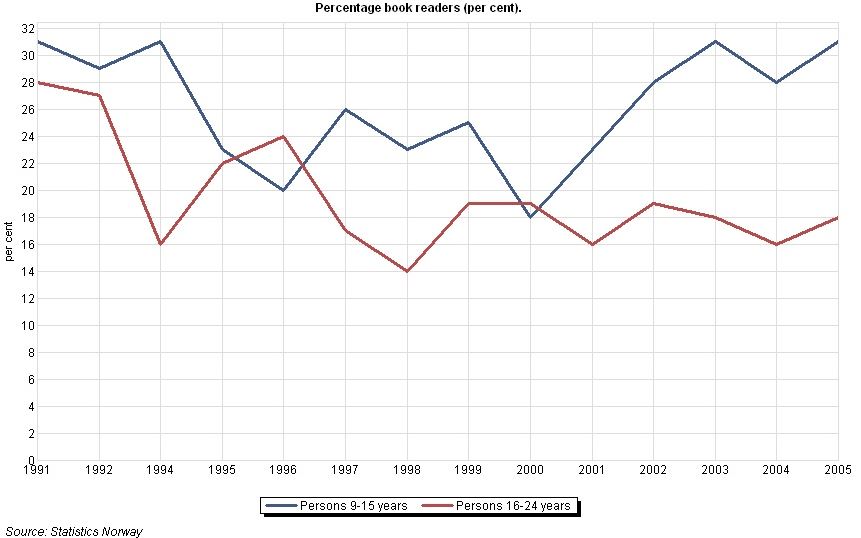
and although there might be somewhat of a Harry Potter effect for the youngest in the beginning of the 2000’s, time spent reading is quite consistently going down, figure_media_percentagebookreaders1991_2005
including time spent on newspapers, figure_media_percentagnewspaperreaders1991_2005

magazines,    figure_media_percentagemagazinereaders1991_2005

and even cartoons. figure_media_percentagecartoonreaders1991_2005

Is that a bad thing? Well, that depends, but if it is passive television entertainment that crowds out reading, I would not be surprised if that had some long term consequences.

Monthly book roundup – 2014 December

Books finished in December:
(Warning: reviews are unpolished and quickly written.)

Being Mortal: Medicine and What Matters in the End (2014) by Atul Gawande. A great book on keeping ones priorities right while dying. No nostalgic – punctures the myth that everything was better was several generations lived together: Separation was a form of freedom, and choices for the elderly have proliferated. Makes the case for hospices and terminal care and life quality rather than treatment, the dying have other priorities than only being safe and living longer, but this often not taken into account by the close ones. “Well-being is more than just health and survival and safety. […] ok to insist that our doctors and our institutions know that and respect that as well.” Definitely recommended. (Gawande has also written other good books.)

Blood in the Cage: Mixed Martial Arts, Pat Miletich, and the Furious Rise of the UFC (2010) by L. Jon Wertheim. Entaining read about the rapidly growing sport of mixed martial arts, by an enthusiast.

The Company: A Short History of a Revolutionary Idea (Modern Library Chronicles) (2005) by John Micklethwait. The history of the company. I liked the first, historical parts best.
Share risks and rewards. European monarchs created chartered companies to pursue their dreams of imperial expansion.” Ex east India Company, Virginia Company. Limited liability was key. “[T]he three big ideas behind the modern company: that it could be an “artificial person,” with the same ability to do business as a real person; that it could issue tradable shares to any number of investors; and that those investors could have limited liability (so they could lose only the money they had committed to the firm).”
1.
Violent history, now different. Slavery, war, etc.
Merchants and monopolies. State monopolies inefficient. In Europe at least internal competition.
Unlimited liability. De Medici innovative-separate partnerships and profit sharing arrangements.
Northern Europe: copies much from Italy,but most imp contribution was guilds and chartered companies. Corporate bodies started, immortal. Towns, guilds, etc.
2.
Royal charter-exclusive trading rights. Joint stock company. Start to buy shares, and limited liability. East India company troubled initially, but managed. Exclusive rights to sell tea in the American colonies-Boston tea party. Monopolies, criticism from Adam Smith. Courts. Government of big organizations and many people.
3. A prolonged and painful birth 1750-1862
Reinvigorate the idea of the company. Partnerships most common, but unlimited liability a problem. State competition to have the least regulation in order to attract companies. Railways changed things.

Recommended for the historical parts.

Rise of the Warrior Cop: The Militarization of America’s Police Forces (2014) by Radley Balko. A disturbing book about the American Police Forces.

The old “Castle doctrine” (A man’s house is his castle) is now broken, no knock warrants and raids have become common. Maybe too rosy view of self-governing communities depending on mores, etc before. General Patten revealed as mad, wanted to shoot and leave dead rebellious citizens.
The name SWAT was originally “Special Weapons Attack Team”, but was changed to “Special Weapons And Tactics” because that sounded less aggressive.
Two-sidedness of the commerce clause governing federal power over the states – civil liberties and Nixon’s crime on war and drugs. Villain Nixon-hid statistics, ordered easy arrests, could “stick it to the left” with his Supreme Court nominees.
Swat proliferation, started for exceptional cases of hostage taking and emergencies. Civil asset forfeiture. Drug raids became source of revenue. Impunity. Extreme increase in swat raids, and not even in cases of violent crime, mostly for drug raids. Swat more problematic in small places, not enough training and personnell.
States decriminalizing medical marihuana, but people still targeted by federal authorities-FDA.
Often wrong door, botched raids, accidental deaths. Also poker raids. And raids under the guise of food inspection etc. Bizarre: Shaquille O’Neill and Steven Seagal joining in raids for tv shows. Military equipment more and more common.
Cable tv and cop series->violence.
Police unions a problem. Advocates cameras and liability for police officers. Public needs to start caring; some positive signs.
Recommended.

The Clockwork Universe: Isaac Newton, the Royal Society, and the Birth of the Modern World (2012) by Edward Dolnick. The scientific revolution. Easy listening for nerds. Recommended.

Capital in the Twenty-First Century (2014) by Thomas Piketty. Deserved its own review. Recommended.

The Haves and the Have-Nots: A Brief and Idiosyncratic History of Global Inequality (2010) by Branko Milanovic. I liked this book. Short, many facts. The stuff about the EU vs US gini coefficient was interesting (coefficient about the same, but in EU much more inquality between states). Recommended. Below is a kind of summary.

How income and affluence present in daily life
“The objective is to unveil the importance that differences in income and wealth, affluence and poverty play in our ordinary lives as well as the importance that they have had historically”
1. Inequality between individuals in a community
2. Inequality in income between countries
3. Inequality globally. Increasingly important
-essay-Vignettes
Focus on disposable rather than marketable income.

1. Study of distribution important historically. Among social classes-workers capitalists landowners. Pareto started with individuals. Iron law-80/20. Kuznets theory of change, inverted u. Later augmented K curve.
Good and bad inequality. Keynes quote, view of capitalists as savings machines. Social monopoly vs incentives.
Atkinson welfare measure-equally distributed, equivalent income. But dependent on adding utilities. And higher u functions-Sen. Pareto criterion, but almost impossible to satisfy in the real world. Rawls: “Injustice is simply inequalities that are not in the benefit of all”, and in particular the poor.
Measurement of inequality. First about finding technical measure satisfying certain axioms. Gini. Lack of data, fiscal records often about taxes and without income and consumption, use hh surveys, but these also often not available.
Top income share, gini, etc. Between and within inequality decomposition.
Vignette 1.1. Pride and prejudice contains economics, love-wealth trade-off. Same today, but stakes do change. Anna Karenina, ratio between possible incomes w different husbands, like England stakes changes in Russia. 1.3. Richest ever, consider amount labor that could buy locally with yearly income-modern richer-Carnegie-Gates-Rockefeller. But locally khodorkovsky richer, and Slim even more. 1.5 Was socialism egalitarian? Yes, but lack of incentives, nothing exported, political inequalities, privileges, priority for goods, behavior of elites stood out. 1.7 Who gains from fiscal redistribution? The poorest, but not upper middle. 1.8 several countries in one? In Soviet Union as different as South Korea and Ivory Coast. Rich territories wanted out. In Yugoslavia regional income ratio as big as 8:1, Slovenia vs Kosovo. Raises questions about china, eu, Nigeria. 1.9. China unity survive? Soviet dissolved. Am inequality distributed more broadly, soviet regionally, like in china. Some regions (5+6?)-gang of maritime cities and provinces . 10:1. But language similar and history shared. But ethnic cleavages. 1.10 Pareto and Kuznets. Functional vs interpersonal. Recent tensions between “inequality” and “poverty”. Pareto controversial, anti-socialist. Pareto constant. Human history is history of aristocracies, some elites always in top.

2. Unequal nations
Used to be small, big started with industrial rev until 1950’s. Two methods: unweighted and weighted by population. Same previously, now more diverging last 30 years. More nations and comparability in space and time are problems-construct the new nations and use PPP. Intercountry inequality increased. But when use weighted measure, dampened, though absolute differences still huge, so poor countries need to grow at extremes just to keep up, since so low base.
Neoclassical economics: globalization->convergence, because of fdi, copy easier, specialization, can use good ideas. But we have seen divergence-have not seen much foreign investment, technology does not come free (ref e.g. IP rights).
2.1 Marx. Real wages actually started to rise around publication of Das Capital. Global inequality used to be driven by class, now by location. Third world solidarity has plummeted. 2.2. GDP is about averages. Within nation inequality needed. First divide a nation into 20 income groups, ventiles, convert income by PPP, find position of each venture in the global income distribution. Brazil extreme, covers almost from top to bottom, many countries, ex India where richest ventile is poorer than poorest of US. With percentiles a little overlap. Citizenship is fate.
2.2. How much income inequality determined at birth? Place of birth explains more than 60% of variability in global inequality. With income class of parents as well, more than 80% explained. Portion left for effort small.
2.4 Migration. A rational response to inequality. Income inequalities rising, so also migration pressure. Both push and pull factors. Integration issues. Mexican wall going to be longer than Berlin Wall.
2.5. Hraga. People who burn their papers. Frontex costs as much as what the travelers pay. Lampedusa-“the camp of identification and expulsion”. What to do with the dead bodies? Algeria did not want them. Rethorical question: “can these separate, and unequal worlds coexist…?”
2.6. Three generations of Obamas.
2.7. Globalization has not decreased inequality. And deglobalization in the beginning of 1913-38 did not increase inequality. WWII: divergence- some countries grew much positive or negative. Great Depression: rich countries lost, many others not much affected.

3. Unequal world
Inequality among citizens in the world. Do not have the data globally for before. But recent years, 1988 onwards, have good household surveys for most countries. The world extremely unequal, high gini around 0.70. Decile ratio about 80:1. In dev countries seldom above 10:1. Probably not more unequal since late 80’s. Forces for greater inequality: rising within countries and divergence of incomes between countries. Force for smaller inequality: fast growth of china and India, faster than works average. Trilemma: globalization, increasing between-country inequality, restricted migration. 3.2. Talk of global middle class exaggerated. 3.3. Eu gini about the same as in US, but structure different: more inequality between nations in eu. Social policies should target countries in eu, poor people individually in US. Positive to free circulation of people within EU-cause to believe that poor countries will catch up. 3.5. Capitalist European football system.
Rawls migration: not concerned with global inequality, takes peoples as given, and differences in their preferences; Burdened and ordered countries.
Wants EU to help Africa.
Key challenges: “how to bring Africa up, how to peacefully bring China in, and how to wean Latin America of its self-obsession and bring it into the real world, and doing all if these while maintaining peace and avoiding ideological crusades.”

A Daughter’s Memoir of Burma (2014) by Wendy Law-Yone. About Burmese newspaper man Ed Law-Yone working in Burma under the military dictatorship, written by his daughter. Picked the book up since I was going to Myanmar/Burma, but it was way too slow capture my attention.
Ratings and old books are in the library.

Review: Capital in the 21st Century by Thomas Piketty

Now I have done my share to make Capital in the Twenty-First Century by Thomas Piketty a little less unread. Good timing, since he is visiting Oslo this week.

What I will write here will be the notes I took while reading the book, edited for clarity. It is well known now that the book is thick and contains very much information, Piketty explicitly wants to consider both big and small phenomena, both long and short term changes, hence disclaimer: There will inevitably be much that I will not have caught or write about, and there may also be things that I have misunderstood. But maybe these notes will be helpful for those who have themselves read parts of the book or know a little bit and are trying to understand more. Many others have written better proper reviews.

Conclusion: Much great empirics to learn from. Inequality is an important topic. Good figures. Good at using qualifications and caveats, necessary when writing such a broad book. Good that also tries to explain. Objections by others that the recent rise in inequality is caused by human capital, etc. are misguided. Fundamentals of and cause and effect relationships in theoretical framework should have been clearer, and objections often relevant. Recommended.

Part One: Income and capital
-Focus on US and France, to some extent Germany, Britain, and to a lesser extent Sweden.
-Convinced that inherited wealth will make a comeback.
-The capital/income ratio is defined as β = K/I. It is fine to call and think of capital as “wealth”. This ratio was quite high in the time around 1900 (about 7), meaning that there was a lot more wealth than income. This was a period with very high inequality, particularly in Europe. But with depressions and world wars, much capital was destroyed, thus β declined. In the post-war period, β has been rising again.
-The first fundamental law of capitalism: α=r x β. This is an accounting identity saying that capital’s share of income α equals the return on capital r times the capital/income ratio β. W
-The second law: β = s/g. s is saving. Also like an accounting identity. Supposed to hold asymptotically.
-Capital ownership is concentrated, so a high capital/income ratio is typically related to inequalty.
-Suggests competition between nations-> conservative revolution, Thatcher etc.
-Growth pessimist. Refers to his figures 2.2-2.5 as this largely determined but immediately afterwards when discussing inflation mentions that quality improvements and new products may mean that the growth rate really higher. In any case his growth pessimism is key since it means “wealth accumulated in the past will inevitably acquire disproportionate importance (p. 166).”
-Piketty emphasizes both that the capital/income ratio has increased and that inequality has increased since the world wars, and that r>g is a force for greater inequality, but he stresses repeatedly and clearly that r>g is not what is driving this recent rise in inequality. So people saying things like “Piketty is wrong because he claims that the rise in inequality is due to capital income while in truth it is due to a rise in wage inequality” (a group including notables such as Debraj Ray) simply cannot have read the book seriously. Indeed the point of a rise in wage inequality is treated at considerable length and referred to repeatedly. I have mentioned this before.
Part Two: The Dynamics of the Capital/Income Ratio
-On the other hand, his use of the “second law” β = s/g is a legitimate target for criticism, since he writes as if s and g are exogenous and independent variables determining the capital/income ratio, which is clearly not the case.
-The fundamental force for divergence: r > g. This has more bite than the “laws”. Piketty takes it as an empirical fact that the rate of return on capital, r, historically has been greater than economic growth g. In his view, the second half of the 20th century, in which the opposite was the case is an exception. Debraj Ray has forcefully attacked the emphasis on this inequality, pointing out that it is the saving propensities of the rich versus the poor that matters, not the form of their saving (here and here).
-Piketty refers to 19th century literature throughout, but he does so to show certain features of the economic environment: in the novels of that time there was no inflation; and the rate of return on capital was constant – capital and rent of ca 5% considered the same, and type of capital seen as unimportant (p 207).
-Most wealth privately held, tab 3.1.
-p 151 strange about “inevitably” about volume and price effects in housing.
-p 163 takes swipe at authors of wb reports regarding monetary value of hum cap.
-Volume effects, like savings, together with slow growth explaining most (though not all) of increase in private cap from 1970s. Ex of second law. Privatization also a cause, and increase in asset prices. Might one make the arg that privatization increased value? Higher value placed on the privately held capital.
-Rate of return depending on size of capital. I come back to this under Part three.
-p 220: “the novelty of this study…capital-labor split and the recent increase of capital’s share of national income in a broader historical context by focusing on the evolution of the capital/income ratio from the eighteenth century until now”.
-Acknowledges role of recent prod growth and diffusion of knowledge – have made it possible to avoid the apocalypse predicted by Marx (p. 234). But has not altered the deep structures of capital. Also sees “progressive taxes on income and inheritance (p. 278)” in the postwar period as reasons why rentiers have not come back.
Part three-the structure of inequality
-Destruction of war, bankruptcies in depression an policies like rent control reduced wealth inequality, allowed new start.
-France: large decrease in inequality since the Belle Époque, driven by income from capital (figs 8.1-2). Increase after WWII, due to both capital and labor, decrease from 1968, when minimum wage was increased faster than the average wage, then increase from 1982-83, when this policy was stopped. Overall, though, wage inequality stayed about the same, but increased at top end of the distribution since 1990’s.
-US: started the 20th century as more egalitarian than France and Europe, but has now overtaken them and become as unequal as France was at that time (fig 8.7). Decreased in prewar and WWII times, but has shot up sine the 70’s due to the rise of “supersalaries” going the top 1 percent income receivers (fig 8.8).
-The very rich still get most of their income from capital in both France and US. Figs 8.3-4 and 8.9-10.
9. Inequality of labor income
-Also consider other countries. Many of the same developments.
-Thinks we are not going away from society of rentiers, only going to another form. Agrees with Goldin and Katz that increased spending on education would be good, but considers the wage-according-to-skill-only-story, or the theory of marginal productivity, as incomplete, since “it fails to explain the diversity of the wage distributions we observe in different countries at different times (p. 308)”, sees it rather as holding in the long run. Also mentions the intrinsic value of health and education. In the US the minimum wage has gone in the opposite way as in France (fig 9.1). Minimum wage can be efficient if firms have monopoly power, this is its justification. Hard to see differences in objective measures if skill between top and almost top income earners; supermanagers emerged mostly in Anglo-Saxon countries, but not other developed countries. Social norms and acceptability. Difficult to explain observed pay differences by non-external variances-“pay for luck” present, and more so in countries with lower top marginal tax rate. Bargaining model-with lower marginal taxes, it paid for executives to bargain harder.
10. Inequality of capital ownership
-Is becoming increasingly concentrated.
-Wealth more concentrated. Data go longer back. Wealth inequality decreased substantially in the first half of the 20th century, some wealth going to “the patrimonial middle class”, the middle 40% of the wealth hierarchy. Decrease largely due to the shocks of 1914-45 and introduction of taxes on capital and capital income.
-Predicts that r will again rise above g, but says at the same time that this prediction rests on the assumption “that no significant political reaction will alter the course of capitalism and financial globalization over the course of the next two centuries (p. 358),” which is dubious “precisely because it’s inegalitarian consequences would be considerable and would probably not be tolerated indefinitely (p. 358).” This feels somewhat like overhedgning.
-Demographics also relevant. And international competition may drive capital taxes down.
11. Merit and inheritance in the long run
-Dynamics of inheritance
If r>g “the past tends to devour the future (p. 378)”
“Nearly all of the capital stock came from inheritance (p. 379)”. Drop after the war, but steady increasing (fig 11.1) in France. Can be seen as result of three u-shaped forces: capital/income ratio, mortality rate, wealth at death/average wealth. Shocks of 20th century relevant also here-destruction if what was to be inherited, and many died young. Even if people are paid according to merit, income inequality will turn into inheritance inequality. (Andrew Gelman has an old post related to this). Difference from before: wealth less concentrated, and income and wealth more correlated.
-The global dynamics of wealth
Similar patterns in some other countries as in France, but data difficulties in many countries, so uncertain. Also uncertainties about savings and consumption behaviors.
12. Global inequality of wealth in the twenty-first century
-Share of billionaires in the work is increasing (figs 12.1-2).
-Rate of return depending positively on wealth, ref Forbes rankings, table 12.1.
-University endowments, for which we have good data, also show high return and positive association between wealth and return (fig 12.2). Piketty believes this is due to “economies of scale in portfolio management (p. 450)”. Here the evidence does not seem so strong, and it is difficult to believe that capital owners would not run into diminishing returns at some point.

-Much entrepreneurial wealth on Forbes list, but probably more inherited. And entrepreneurs and their children in any case turn into rentiers. Comments on Gates and Slim on pp. 444-445 with footnote, (individual) merit not so straightforward. (Gates wrote a positive review nevertheless.)

Part four. Regulating capital in the 21st century
-I do not have so much to say about this one.
-The state more involved today than in the past. Taxes increased between 1910 and 1980, after that constant (fig 13.1). Social spending-construction of a “social state”. Mobility relatively low in the US, and “parents’ income has become an almost perfect predictor of university access (p. 485).” Argues for more public financing of universities.
Pay-as-you-go retirement systems connect generations and “makes for a virtuous and harmonious society (p. 488),” but face challenges when r becomes > g, which is the rate of return for these systems. Claims that the volatility of the return in capital was the reason for the introduction of paygo systems after WWII, when many people’s savings had been wiped out (p. 633n45), something I never learned about, and that this justification is still valid today. So how to deal with the challenges of r>g? Raising retirement age is one possibility, but we should be better at distinguishing between types of workers (intellectual occupations and others). Mentions possibility that share of intellectual workers will increase; and “One of the most important reforms the twenty-first century social state needs to make is to establish a unified retirement scheme based on individual accounts with equal rights for everyone, no matter how complex one’s career path.”-too many different rules and too much complexity. Sees the Swedish reforms of the 90’s as largely accomplishing this (p. 490n46).
13. Rethinking the progressive income tax
-Progressive taxes on income and inheritances new in the 20th century. Dismisses a direct tax on consumption quickly (p. 494), promising to come back to it (634n1), but hardly does (only briefly in 638n34). Rise of tax competition among countries, the tax system becoming regressive at the high end of the distribution. Sees this as threatening the common supper for taxation. US and Britain led the introduction of progressive taxes on income and inheritances, and had higher rates than France and Germany (figs 14.1-2). So high (marginal) rates that the purpose was not to raise revenue, but rather to limit such wealth. Rates substantially reduced since 80’s. Do not see effect on productivity, but believes the reduction increased the bargaining power of executives.
14. A global tax on capital
-The ideal tool, would “avoid an endless inegalitarian spiral (p. 515).” A useful utopia. Many challenges, but has some ideas about how Europe could implement it. The alternative is worse-capital control and protectionism, we already see some of this, in governments’ support of national champions. Hails redistribution in the US: Immigration is the mortar that holds the United States together, the stabilizing force that prevents accumulated capital the importance it has in Europe; it is also the force that makes the increasingly large inequalities of labor income in the United States politically and socially bearable. For a fair proportion of Americans in the bottom 50 percent of the income distribution, these inequalities are if secondary importance for the very simple reason that they were born in a less wealthy country and see themselves as being on an upward trajectory (p. 538).”
Other comments
-Wants economists to become more broad social scientists. Disses mathematical economists, then says that we cannot spend time on internal squabbles. I happen to agree w much of this, but it could maybe have been put differently.
-Footnotes contain large amounts of information, but are sometimes only dryly humorous or polemical:
621n57 taxi problem in the EU.
624n20 A&R on Gates and Slim. Also in text, but continues in the footnote.


Monthly book roundup – 2014 November

Books finished in November:
(Warning: reviews are unpolished and quickly written.)

Capital in the Twenty-First Century
(2014) by Thomas Piketty. Deserves its own review. Recommended.


The Circle (2013)
by Dave Eggers. Privacy, surveillance, etc. Takes up important questions, but reads like a caricature most of the time. Not unrecommended.

The Glass Cage: Automation and Us (2014) by Nicholas Carr. It is good that someone is emphasizing the drawbacks and dangers of increasing automation (stop thinking for ourselves, do not learn, do not challenge ourselves, leave power in the hands of others), however Carr’s book is too one-sided to be convincing. That is a pity, since the anecdotes and research that he presents are often thought provoking and potentially important.

The Tyranny of Experts: Economists, Dictators, and the Forgotten Rights of the Poor (2014) by William Easterly. The book is superficial in that it repeatedly and uncritically lumps together technocrats, experts, authoritarians and dictators as tyrants. Read David Broodman’s review to see what I mean. But it also has good parts. Hayek is a hero of Easterly’s and the beginning is a good intro to Hayek’s ideas about knowledge. Rights before economic development is a pet cause, and something too few talk about. (Well-meaning) racism was a crucial element in the development of authoritarian development ideas – the powerful (colonialists, Chinese leadership, or others) had to lead for the benefit of those who were led. Another interesting history part is about research on the role of social and civic capital in the development of in particular Italian city states. Chapters 8-9 on migration are very sensible. Recommended, and do consider his critical words seriously, but ignore the unsubstantive and unnuanced ones.

Consider the Lobster and Other Essays (2005) by David Foster Wallace. Four intelligent and witty essays. I liked best the review of the sports star autobiography genre and the report from a porn film award festival. The title essay about a lobster festival and how the author experienced 9-11 were ok. The book made me want to read more by Wallace. Recommended.

Ratings and old books are in the library.

Monthly book roundup – 2014 October

Books finished in October:
(Warning: reviews are unpolished and quickly written.)

Ancillary Justice (Imperial Radch) (2013) by Ann Leckie. Winner of several of the big science fiction prizes in 2014. The protagonist is an ancillary, a human body inhabited by an AI, named Greq. The AI used to be in control of a full starship including all the ancillaries onboard, but Greq is the only survivor after the starship disappeared for mysterious reasons. We follow Greq on her/his(/its?) quest for revenge. I really liked the idea of an AI in a human body as the main character.

Curious: The Desire to Know and Why Your Future Depends On It (2014) by Ian Leslie. Some good anecdotes and references, like one study from the National Institute of Child Health and Human Development in Maryland, in which “[t]he researchers measured the propensity of 374 five-month-old babies to crawl and probe and fiddle, and then tracked their progress over the following fourteen years. They found that the ones doing best at school aged fourteen were the ones who had been the most energetically exploratory babies.” Claiming that curiosity is the key here is of course jumping to conclusions, but I have always found early (baby-level) markers that predict subsequent behavior very interesting. Many places in the book it is annoying how selection issues are often ignored, Leslie writes uncritically about the “effect” of reading to children, watching television, etc., when it is just run-of-the-mill correlations. In chapter 3 too he starts off unthinkingly critical of the internet, although more nuanced as the chapter went on. An ok book.

A busy month again, although at least I managed one up from the previous month.

Ratings and old books are in the library.

Piketty: “[the powerful force behind rising income and wealth inequality in the US since the 1970s] has little to do with r>g.”

Much of the discussion about Thomas Piketty’s Capital in the Twenty-First Century has been concerned with his “law” of the relationship between the rate of return on capital (r) and the rate of economic growth (g), known as r > g. To such an extent that the Initiative on Global Markets at University of Chicago asked its panel of economic experts whether they agreed or not with the statement:

IGM Economic Experts 2014 Inequality and r versus g

The experts overwhelmingly disagreed.

Piketty’s reply in Slate was:

“I think the book makes pretty clear that the powerful force behind rising income and wealth inequality in the US since the 1970s is the rise of the inequality of labor earnings, itself due to a mixture of rising inequality in access to skills and higher education, and of exploding top managerial compensation (itself probably stimulated by large cuts in top tax rates), So this indeed has little to do with r>g.”

And he did indeed write e.g.:

“In short, two distinct phenomena have been at work in recent decades. First, the wage gap between college graduates and those who go no further than high school has increased, as Goldin and Katz showed. In addition, the top 1 percent (and even more the top 0.1 percent) have seen their remuneration take off. This is a very specific phenomenon, which occurs within the group of college graduates and in many cases separates individuals who have pursued their studies at elite universities for many years. Quantitatively, the second phenomenon is more important than the first. In particular, as shown in the previous chapter, the overperformance of the top centile explains most (nearly three quarters) of the increase in the top decile’s share of US national income since 1970. (p. 315)”

So why did the IGM ask this question in the first place? And why have so many economists been concerned with it? It is of course possible that they have not read the book. However it might also be the case that Piketty must take some of the blame and that in general it was not so clear in the book. At least the back cover text (on Amazon) is pretty ambiguous (though I hope the critics read more than that).

I should maybe disclose at this point that I have not read  Capital in the Twenty-First Century either, although now I might have to.


Monthly book roundup – 2014 September

Books finished in September:
(Warning: reviews are unpolished and quickly written.)

Brick by Brick: How LEGO Rewrote the Rules of Innovation and Conquered the Global Toy Industry by David Robertson. Too much about certain broad, canonical business strategies (“reach for blue ocean markets”) and LEGO’s failures, or rather failed timing, applying these strategies, but maybe that is just how business book are. The thing that keeps the book floating is its case – the Lego brick.

A busy month.

Ratings and old books are in the library.

Monthly book roundup – 2014 August

Books finished in August:
(Warning: reviews are unpolished and quickly written.)

A Short History of Nearly Everything (2004) by Bill Bryson. Great book. Popular science history from the Big Bang to the present. Recommended.

Odalisque: The Baroque Cycle #3 (The Baroque Cycle: Quicksilver) (2006) by Neal Stephenson. Final part of the 17th century historical novel Quicksilver. We initially get back to Daniel Waterhouse, the scientist from the first part (which is also named “Quicksilver”), now becoming a member of the English court. Eliza has financial and other success in the French court. Much high politics involving England, France, the Netherlands and Germany. The catholic king James II is finally deposed in the Glorious Revolution with the help of William of Orange. Entertaining, and it is always good to learn some science and history.

Family Life: A Novel (2014) by Akhil Sharma. Ajay moves with his parents and older brother from India to the land of opportunities US. The accident in which the talented older brother becomes brain damaged changes current and future life of the family. Hardship and lost dreams. OK.

Ratings and old books are in the library.

Monthly book roundup – 2014 July

Books finished in July:
(Warning: reviews are unpolished and quickly written.)

A Failed Empire: The Soviet Union in the Cold War from Stalin to Gorbachev (The New Cold War History) (2007) by Vladislav M. Zubok.

Zukor is professor of international relations at LSE. I enjoyed learning some more about the Soviet Union and Russia, although I guess much, though not all, of the material is well known for people who are knowledgeable about the subject. Zubok writes about the general secretaries of the post WWII period, and claims that the Soviet leaders were often less scheming and more influenced by both ideology and domestic concerns than Western observers often assumed. The first secretary-general of NATO, Lord Ismay, said in 1949 that the purpose of NATO was “to keep the Russians out, the Americans in, and the Germans down.” I would not bet on the incoming secretary-general Jens Stoltenberg making similar remarks.

I found the last part, about the Gorbachev period, most interesting because I found it easier to relate to this newer material. Zubok writes sees Gorbachev as inconsistent, without a plan and no big statesman, but that he was nevertheless important. He writes of Gorbachev that: “His first priority […] was the construction of a global world order on the basis of cooperation and nonviolence. This places Gorbachev, at least in his image of himself, in the ranks of such figures of the twentieth century as Woodrow Wilson, Mahatma Gandhi, and other prophets of universal principles (p. 315).” The way these somewhat idiosyncratic beliefs influenced the general secretary made him have profound historical importance.

Quicksilver (The Baroque Cycle No. 1) (2006) by Neal Stephenson. We follow the fictional character Daniel Waterhouse, a close spectator of the scientific revolution taking place in Britain in the 17th and 18th centuries and the Enlightenment in general. Daniel is a friend and aide of Newton, a member of the Royal Society, and encounters several scientifically significant characters, like Leibniz, Robert Boyle, Robert Hooke, and John Wilkins. This first book of the trilogy Quicksilver ends when Daniel seems to arrive from the US back to England, to which is summoned by Princess Caroline (of Ansbach) to help repair relations between the two great men Newton and Leibniz. Enjoyable.

King of the Vagabonds: The Baroque Cycle #2 (2006) by Neal Stephenson. Second part of the first (long) novel of Stephenson’s “Baroque Cycle”. Centered on vagabond and adventurer Jack Shaftoe. One must love this fellow who when he was a kid earned money by hanging on the legs of people sent to the gallows in order to hasten their death, and later tried the equally morbid profession of test-living in pest-infested houses, but the story was far from as entertaining all the time, and I was happy when I reached the end. I look forward to when the arcs from the two first parts are brought tohether in the third instalment “Odalisque”.

Ratings and old books are in the library.